Distributed Neural Computation on a GPU Cluster
The compatibility of GIAANN Biological Artificial Intelligence and frontier‑scale GPU superclusters
Summary
This post describes a distributed GIAANN training and inference implementation on a large peer-to-peer GPU cluster. The design assumes 1m+ concept columns at ~1GB->1TB each, with most nodes dedicated to storing concept columns in RAM (not used for primary computation), and a smaller batch B of nodes dedicated to primary compute for training and inference.
Storage Layout Assumptions
- Most nodes store a subset (1+) of concept columns (in RAM) and primarily serve data to/from computation nodes.
- Concept columns are large (~1GB->1TB each), so the cluster is storage-heavy relative to compute.
- GIAANNpy currently stores entire concept columns in
database/observedColumnsfiles (typically Ext4 SSD filesystem). In a distributed implementation, concept column features (including their outgoing connections) may be split into separate RAM regions rather than a single large sparse PyTorch tensor to speed up inference.
Training Parallelism (Multiple Sequences)
Description
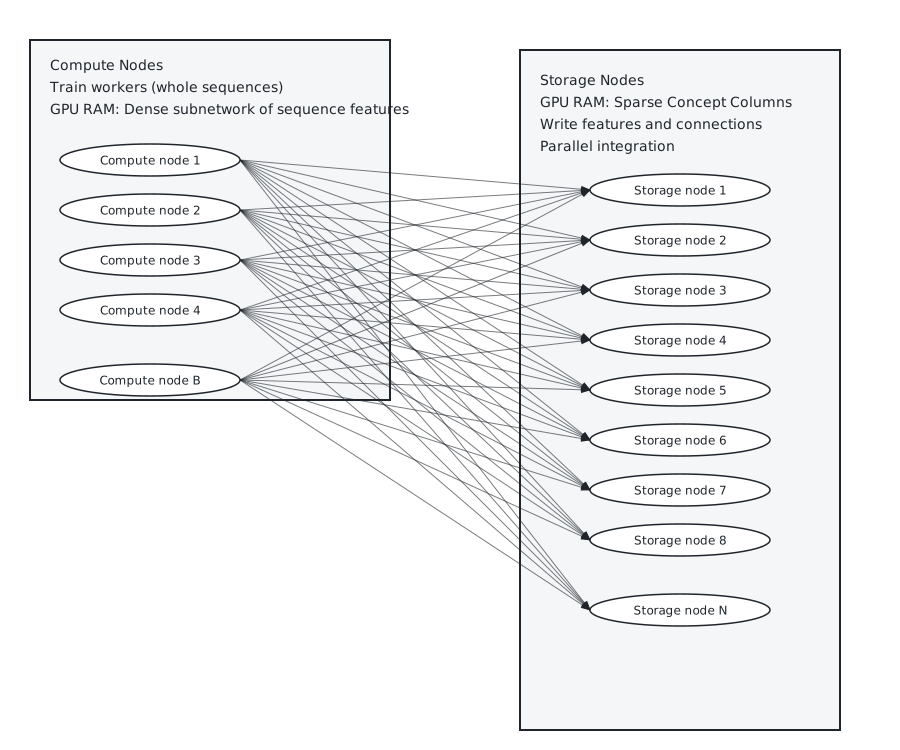
- Each training round (sequence) is assigned to a dedicated computation node.
- Sequences are either randomly selected or preselected to minimize overlap in concept columns, reducing interconnect contention.
- The computation node builds a dense PyTorch subnetwork for the sequence connectivity (see
GIAANNproto_databaseNetworkTrainExcitation.py). - The computation node sends per-sequence concept column data to the storage nodes responsible for those concept columns.
- Transferred data is typically limited to sequence features when
trainSequenceObservedColumnsUseSequenceFeaturesOnly=True(densified view of sparse columns). - Storage nodes independently integrate updates into their sparse concept column tensors (see
updateObservedColumns()inGIAANNproto_sequenceObservedColumnsExcitation.py).
Diagram (Training)
Inference Parallelism (Multiple Sequences)
Description
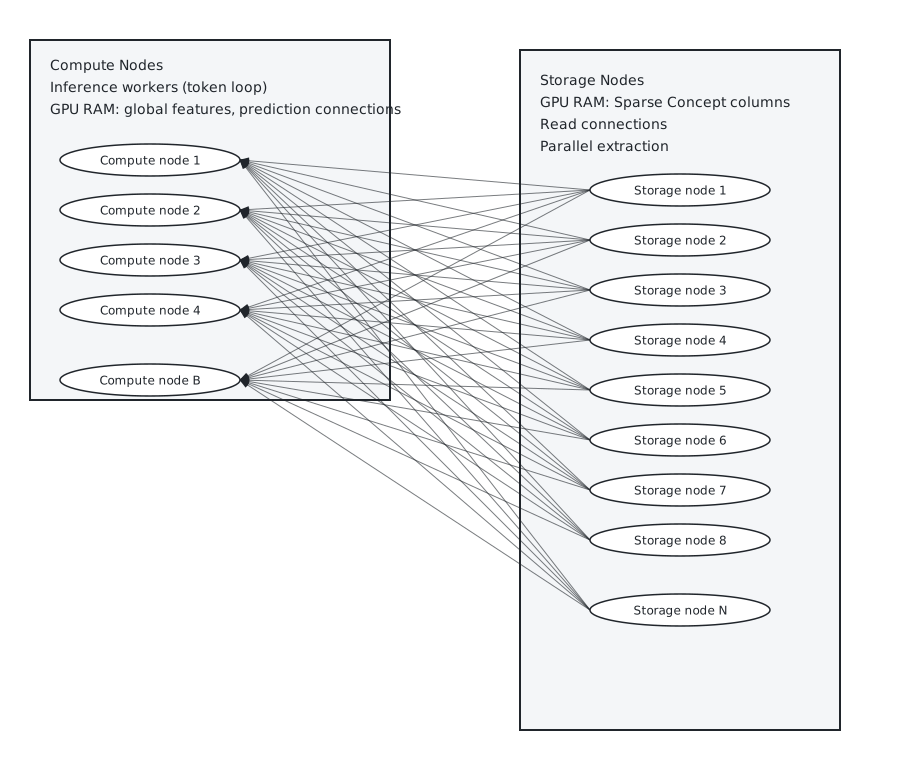
- Each sequence corresponds to a separate user prompt/prediction (inference for a single sequence is not parallelized; it executes per token).
- Each computation node in batch B handles one prompt+prediction sequence.
- Each computation node keeps its own
globalFeatureNeuronstensor in GPU memory (very large, 100GB+ in production). - For each token (inference round):
- The computation node requests the full concept column data for the token (concept column feature), including outgoing connections.
- The computation node computes target activations.
- The computation node updates its local
globalFeatureNeuronstensor. - The process repeats for the next token in the seed/prediction sequence.
Diagram (Inference)
Notes
- The training batch size B is bounded by interconnect bandwidth and storage node parallelism.
- Sequence selection that minimizes column overlap reduces contention and improves throughput.
- Splitting concept column features into multiple RAM regions could reduce sparse tensor overhead for inference.